
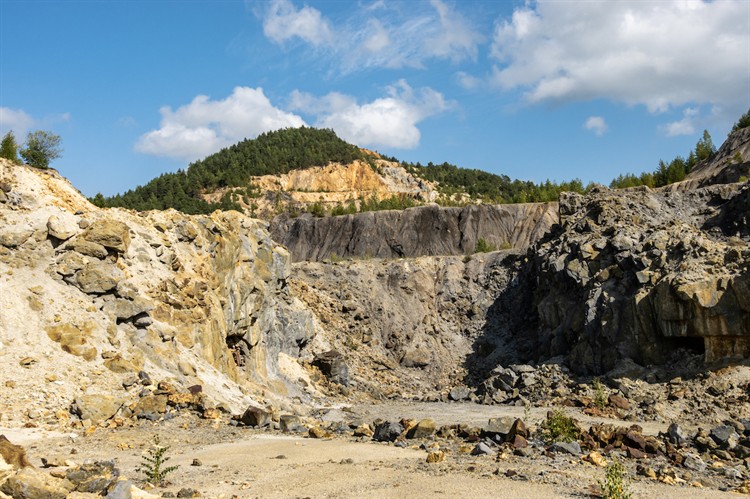
Kyrgyzstan has many of the largest gold mines in Central Asia.
Located on the northern slopes of the Kirghiz Range, in the upper reaches, right components of the Karabulak stream, in the central part of the Bulakashinsky ore fields.
Volcanic rocks take part in the geological structure of the site. rocks represented by andesites and andesite-basalts, their tuffs and clastolavas. Intrusive rocks are represented by gabbro-shonkinites, syenite-diorites and granodiorites, which are separate phases of a single intrusive complex. A characteristic feature of the formations of this complex is their sheet-like, gently sloping occurrence with dip angles from 10 o up to 50 o , in the enclosing volcanic-sedimentary rocks.
With these structures and associated with the formation of mineralized zones and ore bodies of the deposit.
Identified gold and copper mineralization, as well as zones of beresitization and silicification at the Severny site, are confined either directly to granodiorite intrusions, or, more often, their intrusive contacts with host volcanogenic and intrusive rocks.
Zone width beresitization here reaches the first tens of meters. traced length to 400 m. Among the beresites, the most intense veinlet
silicification, bearing disseminated dissemination of sulfides of copper, lead, iron, molybdenum.
Keypoints
The gold deposit is actually one large field consisting of several gold deposits and 1 copper deposit. The seller claims of having a high grade of gold (gold content percentage per 1 ton). However, the field is not well developed. All data is collected by Soviet engineers and it seems nothing is done since that period.
The reserves qualified as P1 and P2 which is by Canadian or Australian standards are equal to: Exploration Results, Exploration Targets, Exploration Potential or even some may be as Inferred. These are lowest level of exploration
Currency: USD
Target Price / Revenue: TBD
Target Price / EBITDA: TBD